Shopping for a home on Grand Traverse Bay or one of our serene inland lakes? The view is only part of the story. Waterfront property comes with specific rights and responsibilities that shape what you can build, how you access the water, and who else can use it. In this guide, you will learn the essentials that every Grand Traverse County waterfront buyer should know, plus a practical checklist to protect your purchase. Let’s dive in.
Riparian vs. littoral basics
In Michigan, “riparian” typically refers to property on rivers and streams, and “littoral” refers to property on lakes and bays. In everyday real estate conversations people often use riparian for both. For clarity here, you will see littoral used for lake and bay frontage and riparian for rivers.
What you generally get
- Reasonable access to and use of the water from your property, including bathing, boating, and swimming.
- The ability to build customary structures such as docks or piers, subject to permits and local rules.
- Rights related to gradual natural changes. Accretion adds land that builds up over time, and reliction exposes land as water recedes. These generally benefit the waterfront owner. Sudden change by avulsion usually does not.
- The right to make reasonable use of the water and shore, consistent with neighbors’ rights and public regulations.
Important limits to know
- Michigan’s public trust doctrine preserves public rights like navigation, fishing, and recreation on many waters and submerged lands, especially on the Great Lakes. As a result, ownership often ends at the ordinary high water mark.
- The reasonable use doctrine prevents you from unreasonably interfering with others’ rights, such as blocking navigation or harming water quality.
- Local zoning, health, shoreline, floodplain, and wetland rules can limit structures, vegetation removal, and alterations.
What is the OHWM?
The ordinary high water mark (OHWM) is the line where the presence and action of water is continuous enough to leave a distinct mark on the bank or shore. It is often identified by vegetation changes, debris lines, or soil characteristics, not by a single fixed elevation alone.
Great Lakes vs. inland lakes
Grand Traverse County includes two different waterfront categories, each with distinct rules and expectations.
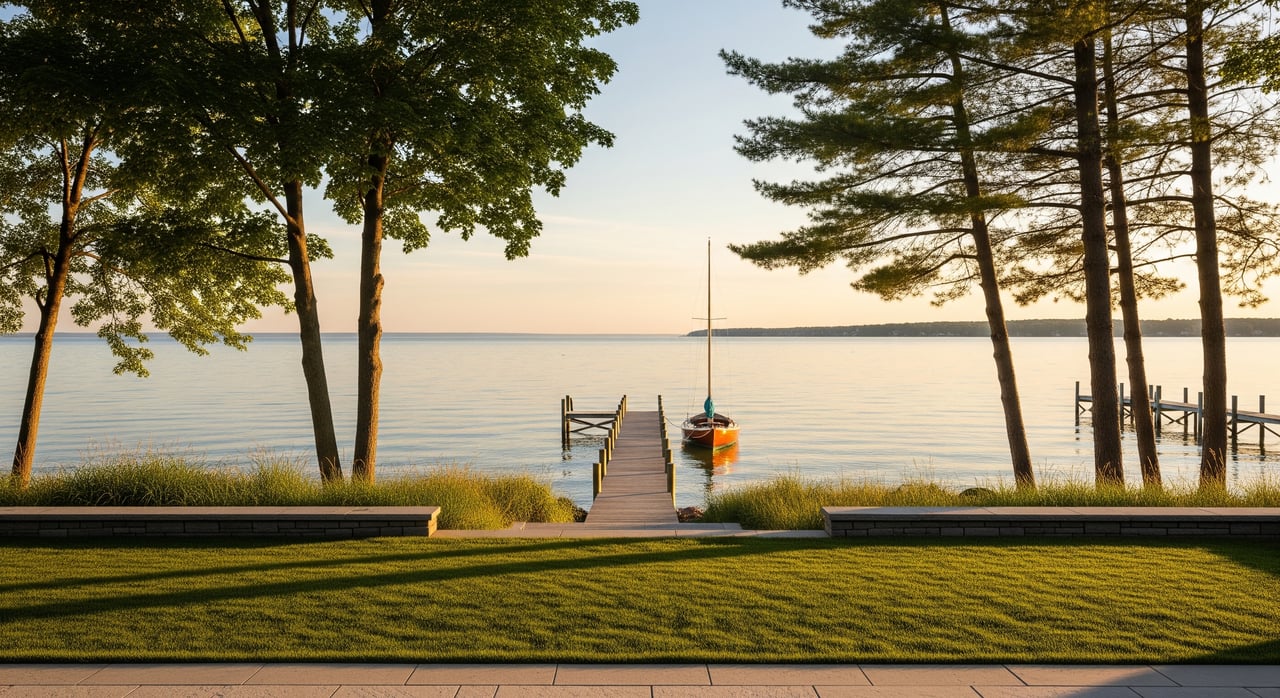
Great Lakes frontage, including Grand Traverse Bay
- The State of Michigan generally holds title to submerged lands below the OHWM.
- Private littoral owners typically own down to the OHWM, not below it.
- Public trust rights are strongest here, which affects docks, moorings, and any fill or shoreline work. State and local permits are common for in-water or shore changes.
Inland lakes and ponds
- Ownership of the lakebed can vary and often depends on whether the waterbody is legally navigable and what the deed or plat says.
- Many inland lake parcels extend title to the water line or, in some cases, toward the lake’s center, but this is not universal.
- You may have more exclusive use directly in front of your parcel than on the Great Lakes, but state rules and recorded interests still apply.
What you can and cannot do on the water
Structures such as docks and piers are often allowed if deemed reasonable and if you comply with permits and local ordinances. For shoreline or in-water work, review Michigan Department of Environment, Great Lakes, and Energy guidance on permits. You can learn more through EGLE’s shoreline and in-water permit guidance.
- Docks and moorings: Size, placement, and seasonality can be limited by township zoning and state rules. Expect to confirm setbacks and obtain permits where required.
- Boathouses and lifts: These are more tightly controlled and may be limited or prohibited depending on the waterbody and local rules.
- Shoreline alterations: Seawalls, riprap, and similar stabilization often need permits and environmental review. Water-level variability on Lake Michigan can make erosion control a priority that should be planned early.
- Public access and use: On Great Lakes waters below the OHWM, the public generally retains rights of navigation and recreation. You cannot exclude lawful public use in those areas. For context on public access facilities and fisheries, review MDNR information on public access and fisheries.
Grand Traverse County local considerations
Waterfront use is shaped by multiple layers of oversight. You will encounter township zoning and planning offices such as Acme, East Bay, Blair, and Garfield, county departments, and state agencies.
- Local rules to check: shoreland setbacks, dock and structure dimensions, vegetation and slope disturbance limits, floodplain and wetland overlays, and septic and well siting standards.
- State agencies: EGLE handles many shoreline and in-water activities, including work lakeward of the OHWM. MDNR manages public access sites and fisheries issues.
- Shared access strips and panhandle lots: Older plats sometimes create narrow access routes or shared frontage. Rights, maintenance, and use limits come from recorded easements, plats, or association documents.
- Lake associations: Many communities maintain shared launches, docks, or beaches. Bylaws and assessments matter for use and budgets.
- Septic systems: Transfers commonly require county health inspections. Failing or undersized systems are material issues for buyers on shorefront lots.
Buyer due-diligence checklist
Use this checklist as you evaluate a Grand Traverse waterfront property.
- Gather recorded deeds in the chain of title, plus the title commitment and preliminary report. Look for any reserved or shared water rights.
- Obtain the plat map and any covenants, easements, or association bylaws, especially for shared access or shared docks.
- Order a current stamped boundary or ALTA survey that shows shoreline, frontage dimensions, and all easements and improvements. Ask the surveyor to note the OHWM if feasible.
- Review recent aerial imagery and county GIS parcel maps to confirm improvements, shore configuration, and neighboring dock patterns.
- Request the property’s permitting history for docks, seawalls, fill, or stabilization. Ask the seller for copies and confirm with the township and EGLE.
- Confirm septic compliance and obtain well records. Note required setbacks from the shore.
- Ask the title company about coverage for boundary-to-water disputes or prescriptive easement claims.
- Consult the township zoning and building departments for setback and structure rules and get written confirmation when possible.
- Engage a local real estate attorney experienced in Michigan waterfront matters to review deed language, easements, and association documents.
- If there is uncertainty about the boundary at the waterline, bring in a licensed surveyor or coastal professional to identify the OHWM on site.
Common deal killers to catch early
- Ambiguous or missing riparian or littoral rights language in the deed.
- Recorded restrictions that limit docks, moorings, or shoreline structures.
- Unclear shared access or maintenance duties for panhandle strips or private beaches.
- Unknown or missing permits for existing seawalls, fill, or large docks.
- Inadequate or failing septic systems that cannot meet shorefront setbacks.
How Craig Real Estate helps
Buying waterfront in Grand Traverse County is both exciting and technical. You want a local team that understands the difference between Grand Traverse Bay frontage and a quiet inland lake, knows which offices to call, and can anticipate common pitfalls before they risk your closing. We coordinate with surveyors, title officers, township planners, and experienced attorneys so you know exactly what you are buying.
If you are considering a cottage, a legacy lake home, or a buildable lot, we will help you structure the right due diligence from day one. From verifying deeded access and permits to aligning your plans with township and EGLE rules, you will have a clear path to the water.
Ready to evaluate a specific property or map out a smart search? Connect with Craig Real Estate to schedule your free consultation.
FAQs
Do I own the lakebed on Grand Traverse Bay?
- For Great Lakes frontage, the State of Michigan generally owns submerged lands below the OHWM, and private owners typically own only to the OHWM.
What is the difference between riparian and littoral rights in Michigan?
- Riparian usually refers to rivers and streams, while littoral refers to lakes and bays. In practice, both describe waterfront usage rights that are subject to public trust and local rules.
Can I build a dock on an inland lake in Grand Traverse County?
- Possibly, if your deed supports it and you comply with township setbacks and any required permits from EGLE and, where applicable, federal agencies.
How do shared access strips or panhandle lots affect my rights?
- Your rights and duties come from recorded documents such as easements, plats, or association bylaws. Maintenance and use limits should be clarified in writing.
What if neighbors or the public use the water in front of my place?
- Neighbors with recorded rights or shared easements may use the water, and the public generally has navigation and recreation rights below the OHWM on Great Lakes waters.
How do water-level changes affect my shoreline boundary?
- Gradual accretion or reliction often benefits the littoral owner, but sudden changes caused by avulsion usually do not alter title. These situations are fact specific.
Who decides where the OHWM is on my property?
- Courts and professionals use physical indicators such as vegetation, debris lines, and soil characteristics. A qualified surveyor can help identify the OHWM on site.
How are waterfront disputes commonly resolved?
- Many issues are settled through negotiation, easements, or shared-use agreements. Litigation may address unresolved title, boundary to water, or prescriptive easement claims.